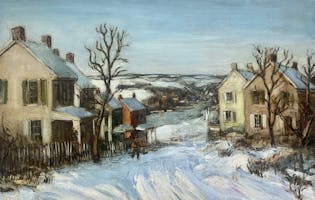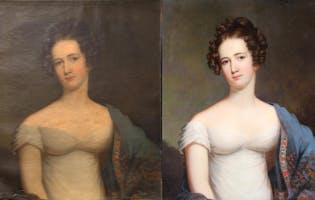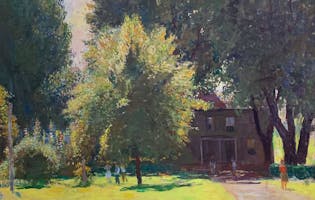
Leonard Nelson, 1912 - 1993


    Leonard Nelson was part of the first generation of abstract expressionists — a group who came to be known as the New York School — along with Jackson Pollock, Arshile Gorky, Willem DeKooning, Mark Rothko, William Baziotes, Robert Motherwell, Clyfford Still, Hans Hoffman, Adolph Gottlieb, Barnett Newman, Ad Reinhart, Franz Kline, Stanley William Hayter, and Melville Price. Leonard Nelson had his first New York solo exhibition in 1949 at Peridot Gallery, followed by his second one man show at Hugo Gallery in 1950. Not only was he shown by Betty Parsons Gallery for three years, but Parsons chose Nelson's work in 1947 to represent her gallery at the all-important Art Institute of Chicago Annual centered on Abstract and Surrealism. Nelson also was shown at Peggy Guggenheim's Art of This Century and Mortimer Brandt Gallery.

Leonard Nelson had been painting for many years before the term "Abstract Expressionism" was applied to the Splatter and Daub School of Painting by Robert Coates, art critic for the New Yorker, in 1946. Nelson is an important figure in the development of Abstract Expressionism in the history of American Art. He has been called a "bridge" between Modernism and Abstract Expressionism. Nelson remained dedicated to this form of painting his entire life and never changed for other more popular forms of painting. In the early 1950s, Betty Parsons told Nelson to paint in a certain style for several years in order to be fully regarded, but Nelson cherished his freedom. A maverick and rebel, he was fiercely independent and a rugged individual. He reacted to Parsons' advice by turning his back on commercial success and leaving New York for Philadelphia, beginning a teaching career that spanned more than forty years. In teaching, he found he could pursue his own vision of art without distraction.

Nelson attended Alabama Polytechnic Institute and received his B.A. degree. Next, Nelson applied for a scholarship at the Pennsylvania Academy of Fine Art, regardless of having no portfolio. He was persuasive enough to be given one semester and subsequently was awarded an Academy fellowship to study painting. Nelson went on to earn the Academy's prestigious William Emlen Cresson award in 1939. He studied at the Pennsylvania Academy of Fine Art from 1936-1940 and then earned a teaching degree from the Philadelphia College of Art. Later, Nelson earned a certificate from the Philadelphia Museum School. The Barnes Foundation also enriched his educational experience where he furthered his studies for five years.

The Cresson Award allowed Nelson to travel to Europe, where he experienced first-hand the great original European works of art and discovered avant-garde and European modernism. Upon his return, the first wages Nelson earned as an artist came from Works Project Administration, just as had many other great artists, like Jackson Pollock and Archile Gorky. The experience actually helped develop Nelson's interest in print making. The WPA project, used silk screens for posters, and Nelson, along with other artists, experimented with the medium to make prints. He also developed several new techniques in block printing. At the onset of World War II, Nelson volunteered to serve one year in the United States Army, originally to be a camouflage artist, but actually ended up painting murals as well as army generals' portraits. While stationed in Texas, Nelson encountered Native American and Pre-Columbian art forms, an experience that would deeply enrich his artistic perspective.

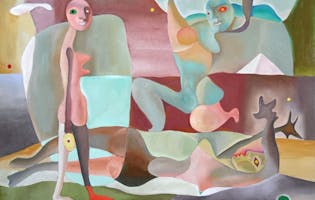
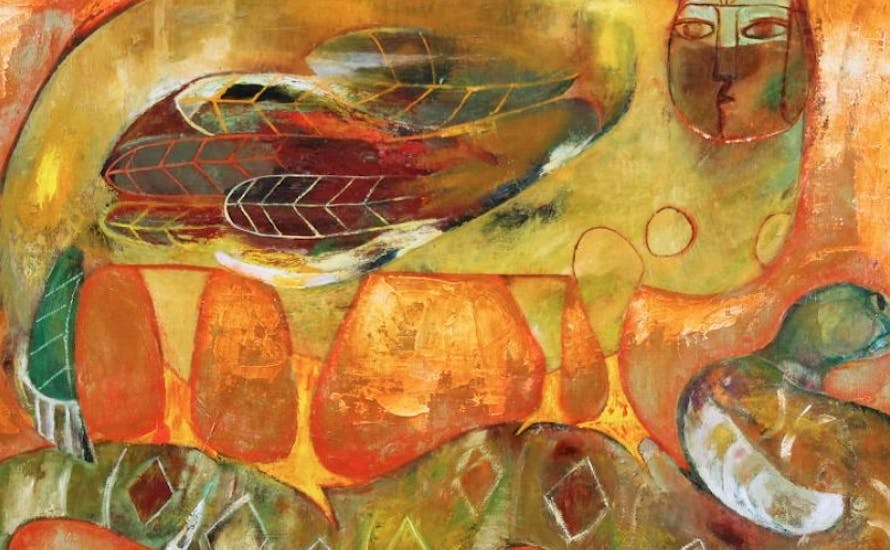
Nelson's works from the 1940s were based on several different subjects. His primitive "forkman and woman" drawings and paintings, with varieties of dancing figures and a type of hieroglyphic, compartmental-style of painting demonstrated the enormous influence of his army experience. He also did a series he called "The Mad Dogs of War," using colorful and violent moving images as a statement to his anti-war sentiment. Leonard Nelson's early work, most noted in his prints of the forties, reflect his protest against violence, fascism and social injustice. Another series, created in concert with John Cage when Nelson lived in New York City on 14th Street, was based on his love of music and dance. In it, lively color and movement evoke images of dancers moving to an unseen, spirited rhythm. Many works are of the bands that played at Billy Krechmer's Jam Session, the notorious jazz club of Philadelphia. Nelson experimented with a "push-pull" style of geometric planes, again, using bold colors. In the early 1950s, Nelson traveled to the Caribbean where he caught at the Centre D'Art in Haiti. Many of his early works from the 1950s were figurative action style paintings with great gesture but a more muted palette.

In 1951, Nelson accepted a teaching position at Moore College of Art in the design and graphic arts department. Later he taught advanced painting and design, and in 1969, he was named director of the Moore College of Art Study Abroad Program, in Florence, Italy. He continued to teach until 1980 and remained professor emeritus until his death.

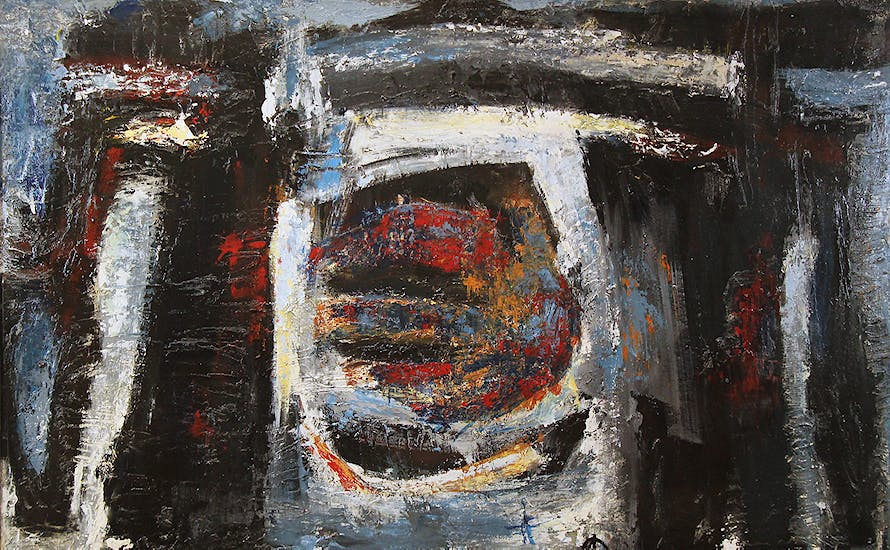
In the 1960s, Nelson created a series of darker works, using a type of collage technique that expressed his rejection of Pop Art and the Vietnam War. He used images of earlier prints and photographs, incorporated between splashes of paint and line. Despite his prolific scholastic achievements, Nelson rebelled against the academic environment, once noted for saying, "All of these 'nice' students painting 'nice' pictures... nudes... still lifes... while outside the world is at war."

Leonard Nelson was a dedicated teacher, painter, sculptor and print maker. Over his career, Nelson had 65 one-man shows in New York and Philadelphia. He taught at the Art Center in Haiti, The Museum of Modern Art, The Philadelphia Museum of Art, The Print Club, Moore College of Art, and The Hussian School of Art. Nelson is represented in many private and public collections including The Philadelphia Museum of Art, The Walker Art Museum, The Dallas Museum of Contemporary Art, The Museum of Modern Art, The Portland Museum of Art, and The Art Museum of San Francisco.

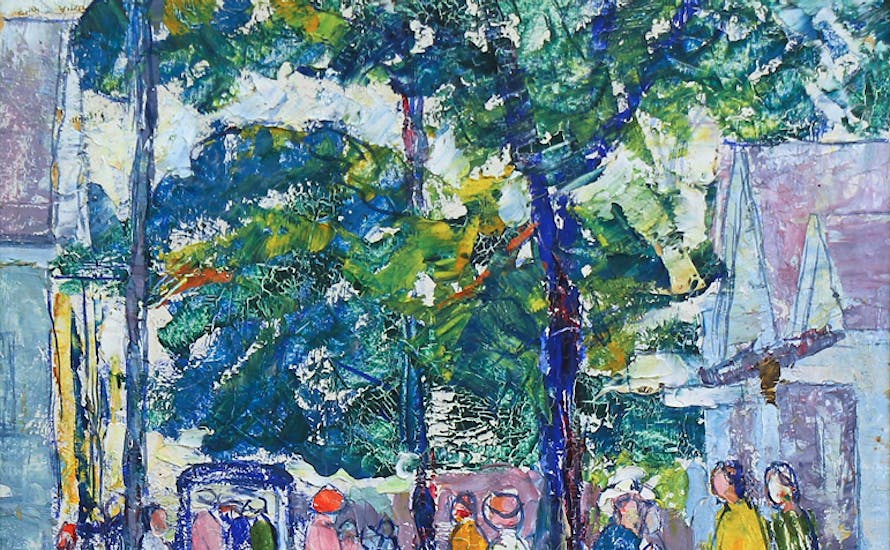
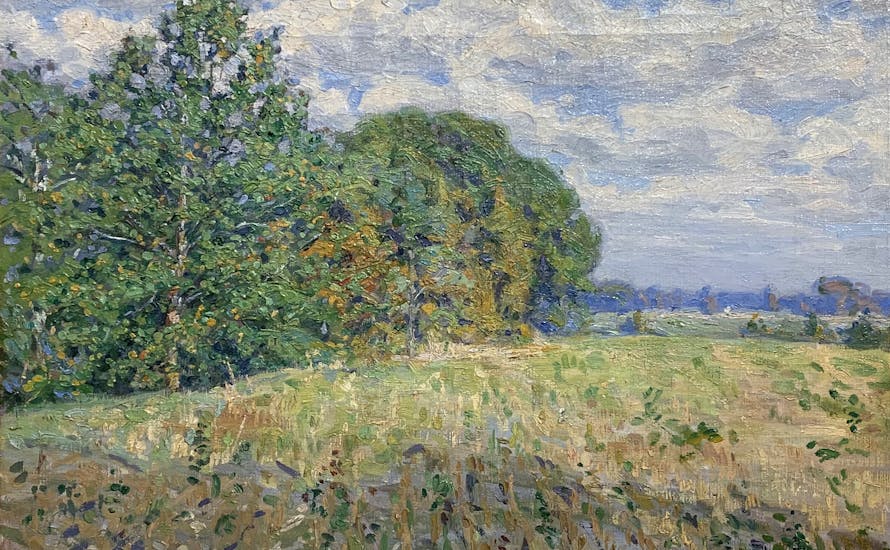
The hallmark of Leonard Nelson's work is color. From the beginning, even in his portraits, interwoven colors can be seen in the background. Nelson possessed a highly sophisticated sense of color, perfected in his work from the 1940s to the 1990s. His Colorfield paintings of the 70s, 80s, and 90s display a rare mastery of color, not easily duplicated, nor found elsewhere.

We invite you to enjoy the exciting and varied works of this gifted painter ...

Browse the Leonard Nelson Gallery

"The Abstract Art of Leonard Nelson" homepage


© Gratz Gallery